
discipline
Discipline That Transfers From the Dojo to Home — and What Doesn't
8 min read
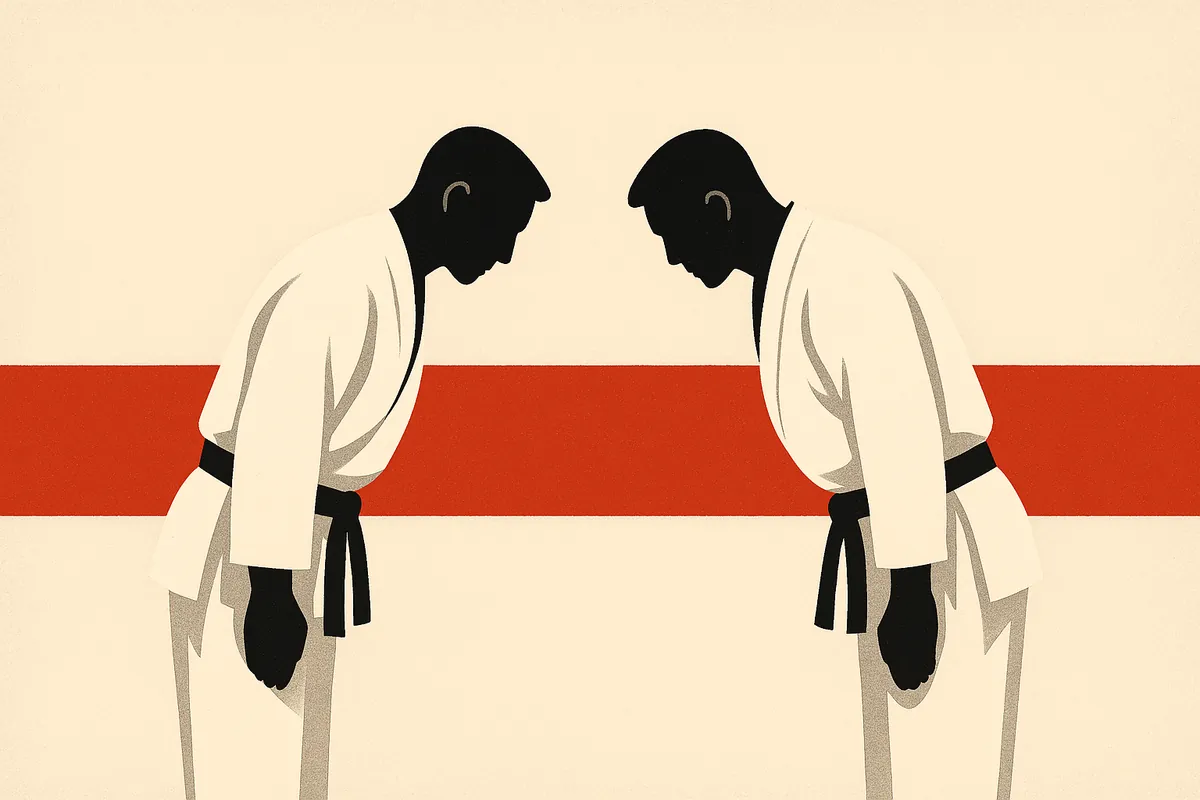
The bow is a boundary, the belt is a record, and neither of them installs a new personality. Here is what a child genuinely learns from being corrected every week, and why the class is the easy half of discipline.
Sit at the back of a class and watch the first thirty seconds and you will see something that surprises a lot of parents. A child walks to the edge of the mat, stops, and bows before stepping on. At home, the same child drops his bag in the hall and walks away from it. The gap between those two children is the question most parents are really asking when they ask about discipline: why does he do it here, and not there?
The honest answer is that the mat does not install a new personality. What it installs is a small set of habits, and habits travel between two places only when the two places agree on the rule. Here is what the rituals actually do, what a child genuinely learns from being corrected, and what you should not expect to change on its own.
What the bow is really for
The bow is not a magic trick, and it is not respect distilled into a gesture. It is a boundary. Every time a student steps onto the mat, that bow says the same thing without a word: the rules just changed. Shoes off, phone away, mouth closed, stand in line. Children read these markers far better than adults give them credit for, and a marker that happens every single time does more work than an instruction that happens when somebody remembers.
It also asks for something specific and small: stop, face front, be still for one second. In the first weeks there are children who genuinely cannot do that, and that is normal. A term later almost all of them can, and nobody has taught them stillness as an idea. They learned it as an action with a beginning and an end.
The third thing the bow does is public. Twenty children stop at the same moment, in front of each other. A rule everyone keeps is a different object from a rule one adult keeps asking for, and that is why the ritual earns its place.
The belt is a record, not a prize
Children read a belt as a prize, and there is no harm in letting a six-year-old enjoy that for a while. What it actually is, is a record: time served and corrections accepted. It moves when the work has been done and a test has been passed, not when the child is in the mood or a birthday has come around.
That is the most portable idea in the building. Progress is attached to a schedule of effort, not to feelings. A child who learns it at seven has an easier time at fourteen, when the work gets long and the enthusiasm has gone quiet.
Stripes do the same job in smaller increments. Each one is a specific thing a student can now do, checked by an instructor who watched them do it. Vague praise is pleasant and it evaporates by dinner. A stripe is a fact the child can point at.
How a child learns to take being corrected
This is the part parents are most curious about, and it looks least like discipline from the outside. Watch a correction in class and it always has the same shape:
- The instructor names one thing. Not five. “Plant your back foot.” Nothing about the child's character, nothing about last week, nothing about being the kind of kid who does this.
- It happens at the moment, not later. Correction that arrives four hours after the mistake is punishment wearing a lesson as a coat. Correction that arrives during the mistake is information.
- The student does it again immediately. Adding “again” after a correction is what turns a sentence into a habit — the body gets to try the new version while the old one is still warm.
- The room watches, and then the next correction belongs to somebody else. A child learns quickly that being corrected is a thing that happens to everyone in the room, all evening, dozens of times.
Say “again”, not “wrong”. A child who hears “wrong” often enough starts protecting himself from the feeling by arguing, deflecting or going quiet, and none of those are discipline. A child who hears “again” learns that the standard is still there and still reachable. It is a small word carrying a lot of weight, and it is the most useful thing a parent can borrow from the way a class talks.
What actually crosses the threshold
Some of it does travel home, and it is worth naming which parts.
- Doing a known thing when you do not feel like it. Not motivation — routine. This is the one that shows up first.
- Being told once and starting. A child who spends months in a room where an instruction is said once and the group moves gets used to the idea that a second asking is not automatic.
- Finishing something with an end point. A form, a drill, a test. Long enough to be tedious, short enough to survive.
- Being corrected without falling apart. The thirty seconds after a mistake get shorter, and that window is the clearest thing to watch in a child.
What does not travel is the automatic version. The mat will not send home a child who hangs his bag up without being asked, and a school that promises that is selling you something. What it can send home is a child who has practised a standard, and a standard is something you can point at instead of arguing about.
Why two hours a week cannot outweigh the house
A class is a small slice of a week. If the mat is strict and the house is negotiable, the child learns something perfectly rational: the rule belongs to the room, and to the person who enforces it. That is not a child being two-faced. It is how people of every age attach rules to places and people, and no one calls that a character flaw.
So I say it before anyone enrols rather than after: the class is the easy half. The two places have to agree on a small number of things, loudly enough that a nine-year-old can hear it.
Three rules worth keeping identical
Not a programme, not a chart on the fridge. Three behaviours, kept the same in both buildings.
- Say it once. In both places. If the third asking is the one that finally works, the first two were rehearsal, and the child is right to treat them that way.
- Follow through. A consequence that appears only when a parent has run out of patience is not a rule. It is a mood with a timer on it.
- Correct the action, not the child. “Shoes in the basket” instead of “why do you never listen”.
And name the bridge out loud, once, without a lecture attached: “In class you would hear that once and get started.” One sentence. It is not a threat and it is not a comparison — it points at a standard the child has already met in another building, which is a much easier thing to live up to than a new one invented at bedtime.
Progress is attached to a schedule of effort, not to feelings. A child who learns that at seven has an easier time at fourteen.
What a class adds that a house cannot
There is one thing a family cannot easily manufacture at home: a room. Thirty children doing the same thing, teenagers and adults training on the same floor under the same rules, and instructors who hold the line every week whether or not they feel like it that evening. Black-belt instructors teach every class at our academies, and that is not a slogan — it is the reason a six-year-old can walk into a Tuesday already knowing what is expected, and find out that he can do it.
It is also why our Gilmer after-school program exists. The hours between the last bell and a parent getting home are exactly when a routine is worth something, and a child who lands at the academy rather than an empty house gets a shape to the afternoon instead of three hours to fill.
When it is more than a discipline question
A last honest note. If what you are dealing with is bigger than tidiness and arguing — if behaviour is affecting school, sleep or safety — the first conversation belongs to your pediatrician, not to an instructor. A class is not therapy and it is not a treatment for anything a doctor would name. What it offers is narrower and still worth having: practice at paying attention, taking instruction and finishing what was started, in a room that is the same every week.
Most of the discipline parents are hoping to see will not arrive as a personality change. It arrives as a hundred small things done the same way in two buildings: the bag hung up, the instruction followed the first time, the mistake corrected without a scene. The mat can start that. The house has to finish it.
If you want the longer version of what training builds, it is on the benefits page. Our Tyler academy and the Mineola academy run the same curriculum, with kids, teens and adults on the same floor, and the events page lists the belt tests where all of it gets checked. Watching a correction happen is the shortest way to decide what you think of it: book a free trial class, or call 903-494-7040.
Published · ProComp Sport Martial Arts
← All articles